Azerbaijan Map
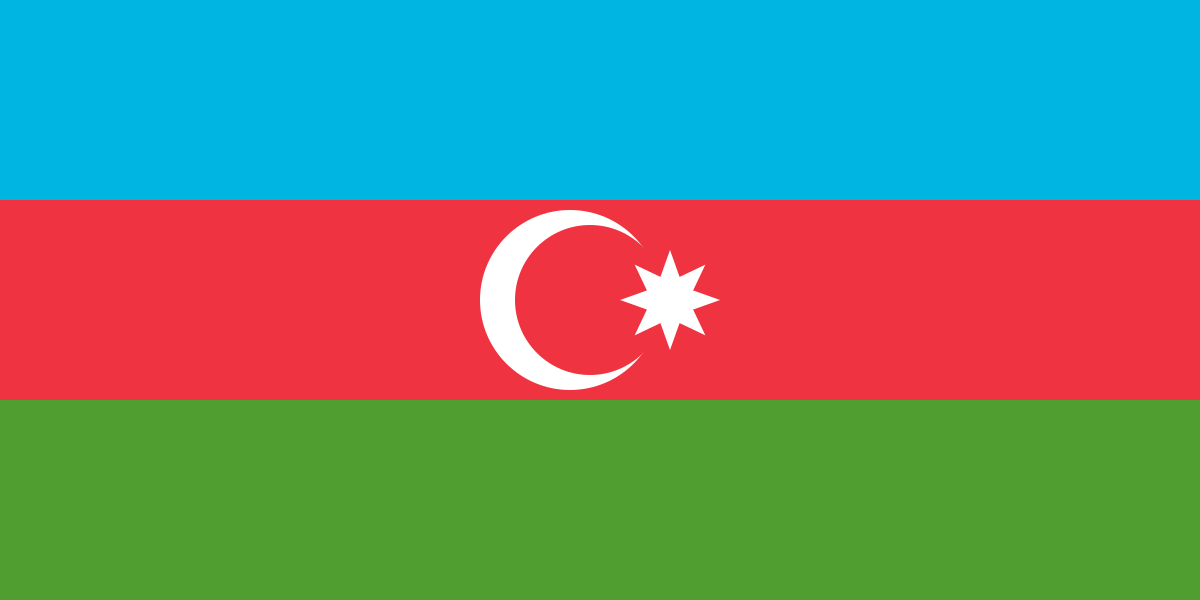
Capital: Baku
Population: 10,397,713
Area: 86,600 km²
Currency: AZN
Languages: Azerbaijani
Religions: Islam
Time zone: UTC+4
Azerbaijan is a transcontinental country located at the boundary of Eastern Europe and Western Asia, in the South Caucasus region. With an area of 86,600 square kilometers and a population of approximately 10.4 million people, Azerbaijan is bordered by Russia to the north, Georgia to the northwest, Armenia to the west, Iran to the south, and has a coastline along the Caspian Sea to the east. The capital city, Baku, is a major urban center known for its oil industry heritage and modern architecture, including the iconic Flame Towers. Azerbaijan gained independence from the Soviet Union in 1991 and has since developed into an important regional energy producer.
Azerbaijan's geography features diverse landscapes including the Greater Caucasus Mountains in the north, the Lesser Caucasus in the west, and the Central Lowlands between them. Mount Bazarduzu, on the border with Russia, reaches 4,466 meters as the country's highest point. The Caspian coastline stretches for approximately 800 kilometers. The country includes the Nakhchivan Autonomous Republic, an exclave separated from the main territory by Armenia. Azerbaijan experiences varied climates from subtropical in the southeast to alpine in the mountains. The country is known for mud volcanoes, having nearly half of the world's total. The Absheron Peninsula, where Baku is located, has been exploited for oil for over a century. The country's landscapes range from semi-desert lowlands to mountain forests, supporting diverse ecosystems despite its relatively small size.
Azerbaijan's economy has been transformed by its substantial oil and natural gas reserves, making it one of the wealthiest former Soviet republics. The GDP per capita is approximately $4,500. The Baku oil fields have been producing since the 19th century, and Azerbaijan was the world's leading oil producer in the early 20th century. The state oil company, SOCAR, dominates the economy. The Baku-Tbilisi-Ceyhan pipeline and other energy infrastructure make Azerbaijan an important energy transit country. The country uses the Azerbaijani Manat (AZN) as its currency. Despite oil wealth, the government has been attempting economic diversification to reduce dependence on hydrocarbons, focusing on agriculture, tourism, and information technology. Agriculture, particularly cotton, grapes, and grain, remains important. The non-oil sector has been growing, though the economy remains vulnerable to oil price fluctuations. Azerbaijan has invested heavily in infrastructure and has positioned itself as a regional transportation and logistics hub.
Azerbaijani culture reflects influences from Persian, Turkic, Russian, and Islamic civilizations. The Azerbaijani language, a member of the Turkic language family, is the official language and uses a modified Latin script since 1991. The majority of the population is Shia Muslim, though Azerbaijan maintains a secular constitution and society. The country has a rich cultural heritage, being the birthplace of the Zoroastrian religion and home to ancient fire temples. Azerbaijan is famous for its carpet weaving tradition, recognized by UNESCO as intangible cultural heritage, with distinct regional patterns and techniques. The country has a strong musical tradition, including mugham, a complex form of art music that is also UNESCO-recognized. Modern Azerbaijani culture embraces both Eastern and Western influences. Baku hosted the Eurovision Song Contest and the European Games, reflecting the country's cultural ambitions. Azerbaijani cuisine features dishes like plov (rice pilaf), dolma, and kebabs, showing Persian and Turkish influences. The annual Novruz Bayram (spring festival) is the most important cultural celebration. Azerbaijan has produced notable poets, musicians, and scholars throughout history, and the country invests significantly in preserving and promoting its cultural heritage while embracing modernization.
Major Cities
- Baku - The capital and largest city with 2.3 million people, located on the Caspian Sea and known for its oil industry heritage and modern Flame Towers
- Ganja - Second-largest city with 335,000 people, an ancient city in northwestern Azerbaijan and cultural center
- Sumqayit - Industrial city with 345,000 people, located near Baku on the Caspian Sea coast
- Mingachevir - Central city with 106,000 people, known for the Mingachevir Reservoir and hydroelectric dam
- Lankaran - Southern coastal city with 85,000 people, located near the Iranian border in a subtropical climate zone
Interesting Facts
- Azerbaijan has nearly half of the world's mud volcanoes, with over 400 scattered across the country
- The country was the world's leading oil producer in the early 20th century, with Baku oil fields producing half the world's oil in 1900
- Azerbaijani carpet weaving is recognized by UNESCO as intangible cultural heritage, with regional styles that have distinct patterns and techniques
- Mugham, Azerbaijan's traditional art music, is also UNESCO-recognized and features complex improvisational compositions
- The country is considered the birthplace of Zoroastrianism, with ancient fire temples still visible near Baku
- Azerbaijan hosted the Eurovision Song Contest 2012 and the inaugural European Games in 2015, showcasing its cultural and sports infrastructure