Cyprus Map
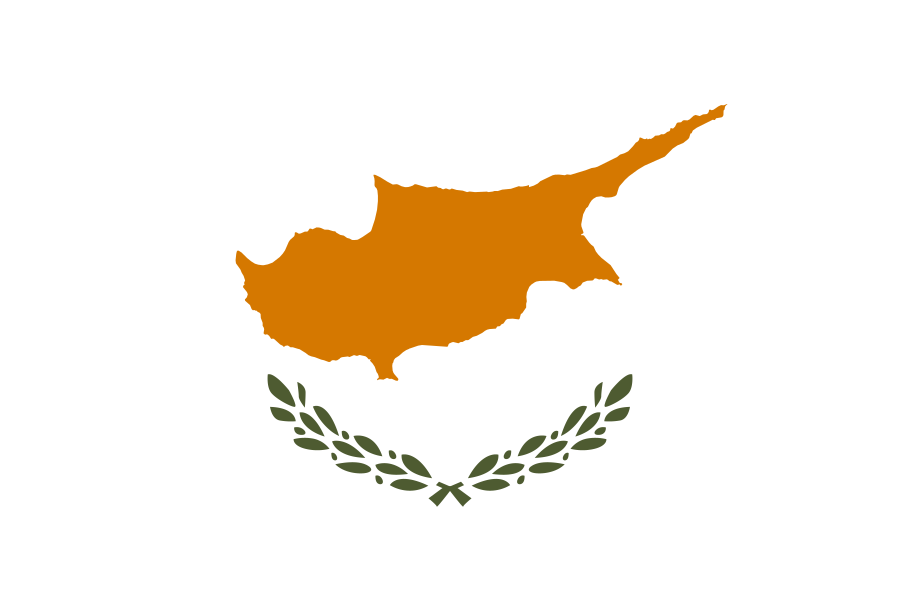
Capital: Nicosia
Population: 1,370,754
Area: 9,251 km²
Currency: EUR
Languages: Greek, Turkish
Religions: Christianity, Islam
Time zone: UTC+2
Cyprus is an island nation located in the Eastern Mediterranean Sea, positioned at the crossroads of Europe, Asia, and Africa. With an area of 9,251 square kilometers and a population of approximately 1.4 million people, Cyprus is the third-largest island in the Mediterranean. The capital city, Nicosia, is unique as the world's last divided capital, split between the Greek Cypriot south and the Turkish Cypriot north since 1974. The Republic of Cyprus gained independence from British rule in 1960 and became a member of the European Union in 2004, though the northern part remains under Turkish administration.
Cyprus features diverse geography with two main mountain ranges: the Troodos Mountains in the south-central region, where Mount Olympus reaches 1,952 meters as the island's highest peak, and the Kyrenia Range along the northern coast. Between these mountain ranges lies the fertile Mesaoria Plain, the island's primary agricultural area. Cyprus enjoys a Mediterranean climate with hot, dry summers and mild, wet winters. The island's coastline stretches over 650 kilometers, featuring beautiful beaches, rocky cliffs, and secluded coves. The Akamas Peninsula in the west remains one of the last undeveloped coastal areas in the Mediterranean. Cyprus's strategic location has made it historically significant for trade and military purposes throughout ancient and modern times.
Cyprus has developed a prosperous, high-income economy with a GDP per capita of approximately $28,000. The economy is dominated by the service sector, particularly tourism, which attracts millions of visitors annually to its beaches, archaeological sites, and year-round pleasant climate. Financial services have been important, though the sector faced challenges during the European financial crisis. The country uses the Euro as its currency. Other economic sectors include shipping, with Cyprus maintaining one of the world's largest merchant fleets, and light manufacturing. Agriculture produces citrus fruits, grapes, olives, and potatoes. The southern part of the island has a more developed economy, while the north relies more on agriculture and Turkish economic support. Recently, the discovery of offshore natural gas reserves has opened new economic possibilities.
Cypriot culture reflects a rich history of Greek, Turkish, and Middle Eastern influences. The island is divided linguistically and culturally, with Greek and Turkish as official languages. The Greek Cypriot majority predominantly follows Orthodox Christianity, while Turkish Cypriots are mainly Muslim. Cyprus has an ancient history dating back to the Neolithic period, with archaeological sites like Paphos and Choirokoitia designated as UNESCO World Heritage sites. The island is associated with Aphrodite, the Greek goddess of love, who according to mythology was born from the sea foam near Paphos. Cypriot cuisine blends Greek and Turkish influences, featuring mezze, halloumi cheese, and traditional dishes like souvlaki and kebabs. Traditional music includes Byzantine chants and folk songs. Despite political division, both communities maintain strong cultural traditions while the island continues to work toward reunification.
Major Cities
- Nicosia - The divided capital with 330,000 people, the world's last divided capital split between Greek and Turkish Cypriot zones since 1974
- Limassol - Southern coastal city with 240,000 people, Cyprus's second-largest city and main port for trade and tourism
- Larnaca - Eastern coastal city with 145,000 people, home to the main international airport and ancient Kition ruins
- Paphos - Western coastal city with 90,000 people, a UNESCO World Heritage site and legendary birthplace of Aphrodite
- Famagusta - Eastern city with 70,000 people, located in the Turkish-controlled north with medieval walls and ghost town district
Interesting Facts
- Nicosia is the world's last divided capital, with a UN buffer zone separating Greek and Turkish Cypriot sectors
- Cyprus is the mythological birthplace of Aphrodite, the Greek goddess of love and beauty, born from sea foam near Paphos
- Halloumi cheese originated in Cyprus and has been made on the island for centuries, becoming an international delicacy
- Cyprus joined the European Union in 2004 and adopted the Euro as its currency in 2008
- The island has 10 UNESCO World Heritage sites including Neolithic settlements dating back 9,000 years
- Cyprus is the third-largest island in the Mediterranean after Sicily and Sardinia