Georgia Map
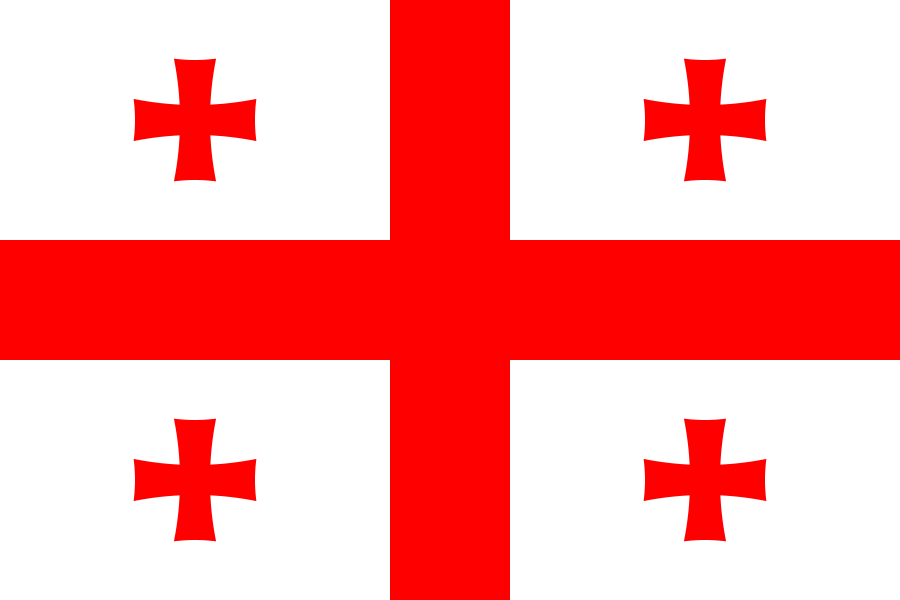
Capital: Tbilisi
Population: 3,806,671
Area: 69,700 km²
Currency: GEL
Languages: Georgian
Religions: Christianity
Time zone: UTC+4
Georgia is a transcontinental country located at the intersection of Eastern Europe and Western Asia, nestled in the Caucasus region. With an area of 69,700 square kilometers and a population of approximately 3.8 million people, Georgia is bordered by Russia to the north, Turkey and Armenia to the south, and Azerbaijan to the southeast, with its western coast along the Black Sea. The capital city, Tbilisi, is a historic urban center known for its diverse architecture and strategic location along ancient trade routes. Georgia declared independence from the Soviet Union in 1991 and has since pursued closer ties with European institutions.
Georgia's geography is remarkably diverse, featuring the towering Greater Caucasus Mountains in the north, including peaks exceeding 5,000 meters, and the Lesser Caucasus in the south. The country experiences varied climatic conditions, from subtropical zones along the Black Sea coast to alpine conditions in the mountain regions. The fertile Kolkheti Lowland and the Alazani River valley support extensive agriculture. Georgia's landscape includes ancient forests, mountain gorges, and numerous rivers that have carved dramatic valleys. The country's natural beauty and biodiversity have made it an increasingly popular destination for adventure tourism and eco-tourism.
Georgia's economy has transitioned from a Soviet-planned system to a market-based economy, with a GDP per capita of approximately $6,300. Agriculture remains significant, with Georgia renowned for its wine production dating back 8,000 years, making it one of the oldest wine-producing regions in the world. Tourism has emerged as a major economic sector, capitalizing on Georgia's rich cultural heritage, stunning mountain landscapes, and Black Sea coastline. Other important sectors include mining, manufacturing, and energy production. The country has implemented business-friendly reforms, earning recognition for its ease of doing business and efforts to combat corruption.
Georgian culture is one of the world's oldest and most distinctive, with a unique alphabet and language belonging to the Kartvelian language family. The country adopted Christianity in the 4th century, making it one of the earliest Christian nations, and the Georgian Orthodox Church remains central to national identity. Georgia is famous for its polyphonic singing tradition, recognized by UNESCO as intangible cultural heritage. Georgian cuisine is celebrated for its diversity, featuring dishes like khachapuri and khinkali. The tradition of the "supra" (feast) with a "tamada" (toastmaster) reflects the importance of hospitality and communal gathering in Georgian society. Ancient monasteries, medieval fortresses, and vibrant folk traditions continue to define Georgia's rich cultural landscape.
Major Cities
- Tbilisi - The capital and largest city with 1.2 million people, Georgia's political and cultural center with diverse architecture and sulfur baths
- Kutaisi - Western city with 150,000 people, Georgia's second-largest city and ancient capital with UNESCO-listed Bagrati Cathedral
- Batumi - Black Sea port city with 170,000 people, modern resort destination and important trading hub
- Rustavi - Industrial city with 130,000 people, located near Tbilisi and center of steel production
- Gori - Central city with 48,000 people, birthplace of Joseph Stalin with a controversial museum dedicated to him
Interesting Facts
- Georgia is one of the world's oldest wine-producing regions, with archaeological evidence of winemaking dating back 8,000 years
- The Georgian alphabet is one of only 14 alphabets in use worldwide and was inscribed on UNESCO's list of Intangible Cultural Heritage
- Georgian polyphonic singing is a unique three-part harmony tradition recognized by UNESCO
- Georgia was one of the earliest Christian nations, adopting Christianity as the state religion in 337 CE
- The country's traditional feast (supra) with elaborate toasts led by a toastmaster (tamada) can last for hours
- Georgia's Vardzia cave monastery complex carved into a cliff face contains over 6,000 rooms across 13 levels