Iraq Map
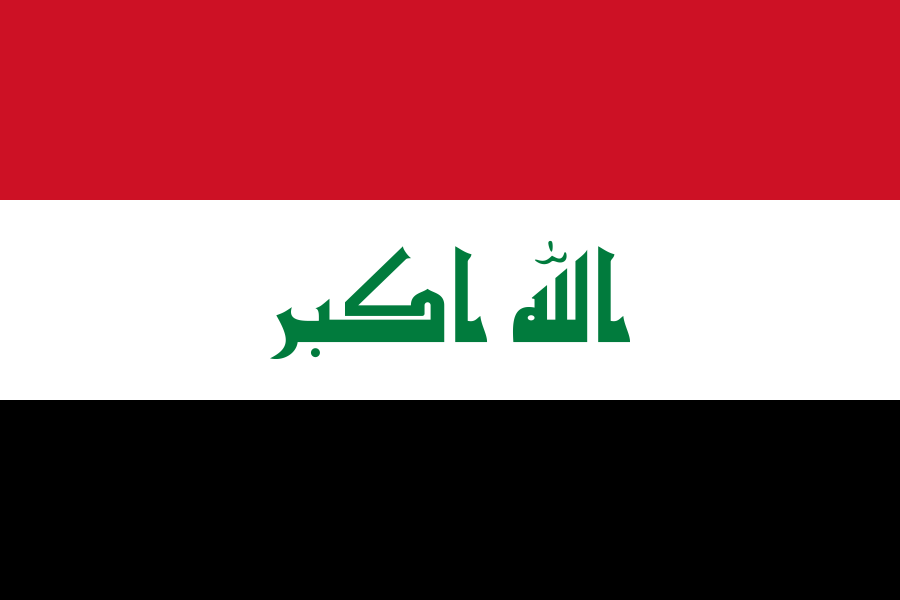
Capital: Baghdad
Population: 47,020,774
Area: 438,317 km²
Currency: IQD
Languages: Arabic, Kurdish
Religions: Islam
Time zone: UTC+3
About Iraq
Iraq is located in Western Asia, bordered by Turkey to the north, Iran to the east, Kuwait and Saudi Arabia to the south, Jordan to the west, and Syria to the northwest, with a small coastline on the Persian Gulf. Covering approximately 438,317 square kilometers, Iraq is home to over 47 million people and sits in the historic region of Mesopotamia, often called the "Cradle of Civilization." This ancient land between the Tigris and Euphrates rivers witnessed the birth of some of humanity's earliest civilizations, including the Sumerians, Babylonians, and Assyrians.
Iraq has an extraordinarily rich history spanning over 10,000 years, being home to ancient wonders like the Hanging Gardens of Babylon and the city of Ur. The region saw the development of the world's first writing system (cuneiform), earliest law codes, and advanced mathematics and astronomy. Arabic and Kurdish are the official languages, reflecting the country's ethnic diversity. Islam is the predominant religion, with both Shia and Sunni Muslim populations. Iraqi culture encompasses ancient Mesopotamian heritage, Islamic traditions, and contributions to fields like mathematics, literature, and architecture, with Baghdad historically being a center of learning during the Islamic Golden Age.
Iraq's geography is dominated by the Tigris and Euphrates river system that flows through the country from northwest to southeast, creating the fertile Mesopotamian plains. The north features the Zagros Mountains along the border with Iran and Turkey, while the west consists of arid desert plateaus extending into the Syrian Desert. The south contains extensive marshlands, historically one of the world's largest wetland ecosystems. The climate is mostly arid with hot summers and mild winters, though the north experiences colder temperatures and snowfall in winter.
Iraq's economy is heavily dependent on petroleum, possessing the world's fifth-largest proven oil reserves, with oil exports accounting for the majority of government revenue. Agriculture remains important in the fertile river valleys, producing dates, wheat, and barley. Baghdad, the capital and largest city, is a major cultural and economic center situated along the Tigris River. Other significant cities include Basra (the main port city in the south), Mosul (historically an important trade center), Erbil (capital of the Kurdistan Region), and Najaf, each playing vital roles in Iraq's economy and its position as a major oil-producing nation.
Major Cities
- Baghdad - The capital and largest city with 7.2 million people, situated on the Tigris River and once the world's largest city during the Islamic Golden Age
- Basra - Southern Iraq's major city with 1.4 million people, the country's main port on the Persian Gulf and center of the oil industry
- Mosul - Northern city with 1.3 million people, historically a major trade center on the Tigris River across from ancient Nineveh
- Erbil - Capital of Kurdistan Region with 900,000 people, one of the world's oldest continuously inhabited cities with a history dating back 6,000 years
- Najaf - Holy Shia city with 800,000 people, home to the shrine of Imam Ali and a major pilgrimage destination
Interesting Facts
- Iraq is home to ancient Mesopotamia, where writing, the wheel, and the first cities were invented around 3500 BCE
- The Hanging Gardens of Babylon, one of the Seven Wonders of the Ancient World, were said to be located in Iraq
- Baghdad's House of Wisdom during the 9th-13th centuries was the world's greatest center of learning and translation
- The Mesopotamian Marshes in southern Iraq are the traditional home of the Marsh Arabs and one of the world's largest wetlands
- Iraq possesses the world's fifth-largest proven oil reserves at approximately 145 billion barrels
- The ancient city of Ur, birthplace of the biblical prophet Abraham, is located in southern Iraq near Nasiriyah