Jordan Map
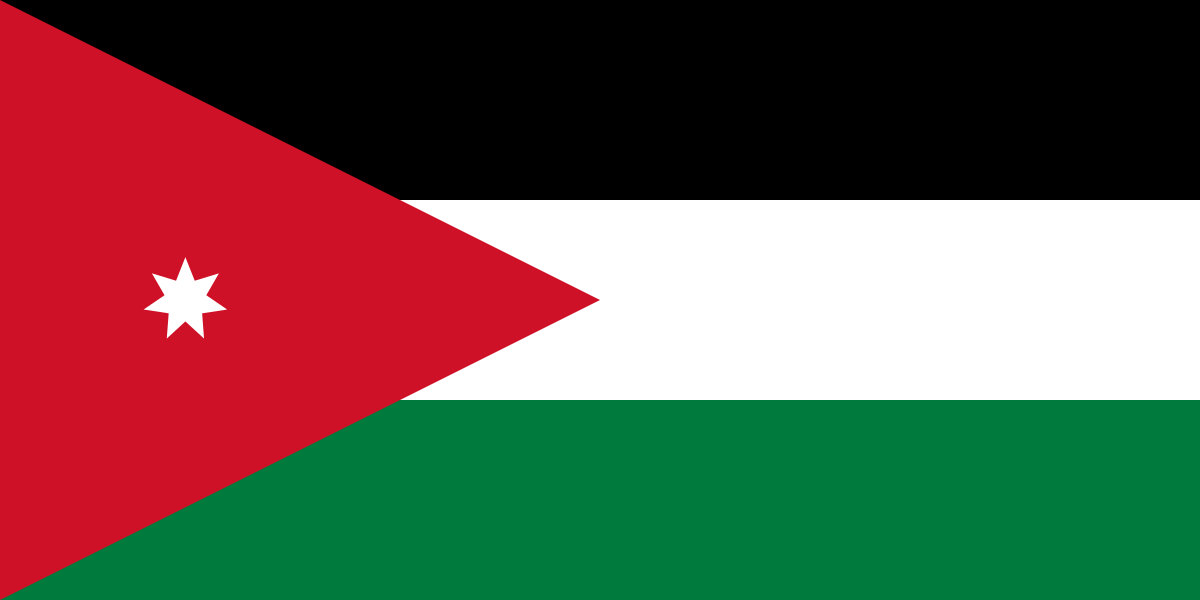
Capital: Amman
Population: 11,520,684
Area: 89,342 km²
Currency: JOD
Languages: Arabic
Religions: Islam
Time zone: UTC+2
About Jordan
Jordan is located in Western Asia in the heart of the Middle East, bordered by Saudi Arabia to the south and east, Iraq to the northeast, Syria to the north, Israel and Palestine to the west, with a small coastline on the Gulf of Aqaba providing access to the Red Sea. Covering approximately 89,342 square kilometers, Jordan is home to over 11.5 million people, including a significant population of Palestinian refugees. Despite limited natural resources and water scarcity, Jordan has maintained relative stability in a volatile region.
Jordan's history spans thousands of years, with archaeological sites like Petra (the rose-red city carved into rock cliffs) dating to the Nabataean kingdom. The modern Hashemite Kingdom of Jordan was established in 1946 after independence from British mandate. Arabic is the official language, and Islam is the state religion practiced by about 95% of the population. Jordanian culture blends Bedouin traditions with Arab and Islamic heritage, known for hospitality, traditional handicrafts, mezze cuisine, and historical sites. Petra, designated as one of the New Seven Wonders of the World, draws visitors from around the globe.
Jordan's geography is predominantly arid desert and semi-arid regions, with the Great Rift Valley running along its western border containing the Jordan River and Dead Sea (the lowest point on Earth at about 430 meters below sea level). The country features highlands in the west and north, while the eastern and southern regions consist of desert plateaus extending into the Arabian Desert. The climate is mostly arid with hot, dry summers and mild winters. Notable features include Wadi Rum desert with its dramatic sandstone mountains, the Dead Sea's hypersaline waters, and the ancient city of Petra hidden in rose-colored canyons.
Jordan's economy relies on services, trade, tourism, phosphate mining, and increasingly information technology and renewable energy. The country imports most of its food and energy despite limited natural resources. Amman, the capital and largest city, is a modern commercial hub situated on rolling hills, serving as Jordan's political, cultural, and economic center. Other significant cities include Zarqa (industrial center), Irbid (educational hub), Aqaba (the vital Red Sea port and resort town), and the ancient city of Jerash, each contributing to Jordan's role as a stable, moderate nation in the Middle East.
Major Cities
- Amman - The capital and largest city with 4.1 million people, Jordan's commercial and cultural hub built on seven hills
- Zarqa - Second-largest city with 635,000 people, an industrial center northeast of Amman
- Irbid - Northern city with 520,000 people, known for universities and proximity to ancient archaeological sites
- Aqaba - Southern coastal city with 190,000 people, Jordan's only seaport and a Red Sea resort destination
- Madaba - Historic city with 105,000 people, famous for Byzantine mosaics including the Madaba Map
Interesting Facts
- Petra, carved into rose-red rock cliffs by the Nabataeans 2,000 years ago, is one of the New Seven Wonders of the World
- The Dead Sea on Jordan's western border is the lowest point on Earth at 430 meters below sea level and has 34% salt content
- Wadi Rum desert, also called the Valley of the Moon, was featured in films like Lawrence of Arabia and The Martian
- Jordan is one of the most water-scarce countries in the world, with limited renewable freshwater resources per capita
- The ancient Roman city of Jerash is one of the best-preserved provincial Roman cities outside Italy
- Jordan has provided refuge to millions of Palestinian, Iraqi, and Syrian refugees, showing remarkable hospitality despite limited resources