Laos Map
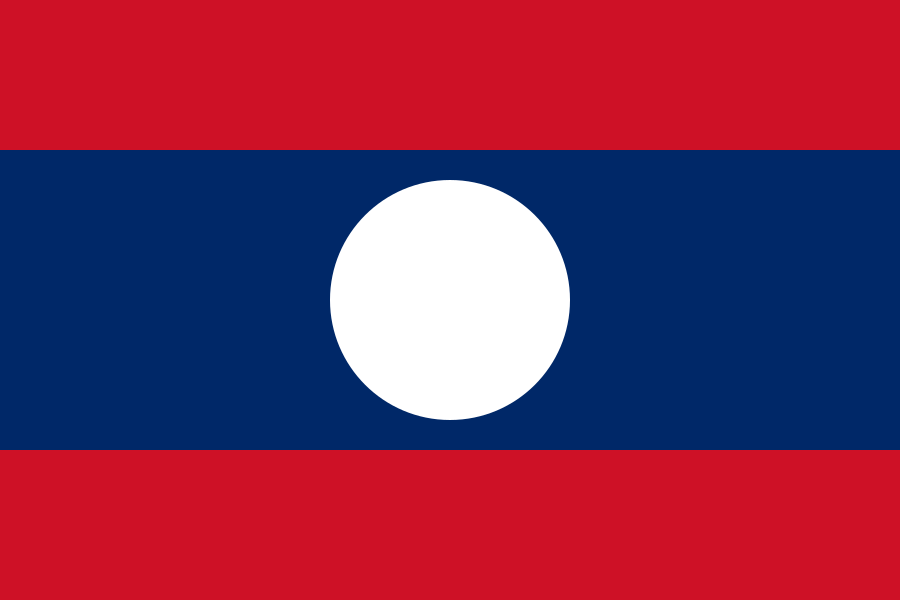
Capital: Vientiane
Population: 7,873,046
Area: 236,800 km²
Currency: LAK
Languages: Lao
Religions: Buddhism
Time zone: UTC+7
About Laos
Laos, officially the Lao People's Democratic Republic, is the only landlocked country in Southeast Asia, bordered by Myanmar and China to the northwest, Vietnam to the east, Cambodia to the southeast, and Thailand to the west and southwest. Covering approximately 236,800 square kilometers, Laos is home to nearly 7.9 million people. Despite being landlocked, the Mekong River forms much of the western boundary with Thailand and is vital for transportation, irrigation, and livelihoods.
Laos has a rich history including the ancient kingdom of Lan Xang (Million Elephants), established in the 14th century. After periods of Siamese and French colonial influence, Laos gained independence in 1953 and became a communist state in 1975. Lao is the official language, and Theravada Buddhism is practiced by about 65% of the population, deeply influencing culture and daily life. Laotian culture is known for its laid-back atmosphere, traditional textiles, Buddhist festivals like Bun Pi Mai (Lao New Year), and the UNESCO World Heritage town of Luang Prabang with its well-preserved temples and French colonial architecture.
Laos's geography is predominantly mountainous and forested, with the Annamite Range running along the eastern border with Vietnam. The Mekong River valley in the west and Bolaven Plateau in the south provide flatter, more agricultural land. The climate is tropical monsoon with distinct wet and dry seasons. Notable features include the Plain of Jars with its ancient megalithic stone jars, the dramatic karst landscapes near Vang Vieng, the Kuang Si waterfalls, and Nam Et-Phou Louey National Protected Area. About 70% of the country is covered in forest and mountains, making it one of Southeast Asia's most pristine natural environments.
Laos has one of Asia's fastest-growing economies, though it remains largely agricultural with rice cultivation, coffee, and timber being important sectors. Hydropower development has made Laos the "battery of Southeast Asia," exporting electricity to neighboring countries. Tourism is growing, focused on cultural heritage and ecotourism. Vientiane, the capital and largest city located on the Mekong River, serves as the political and economic center. Other major cities include Luang Prabang (the ancient royal capital), Pakse, and Savannakhet, each contributing to Laos's gradual economic development while maintaining traditional lifestyles.
Major Cities
- Vientiane - The capital and largest city with 1 million people, located on the Mekong River and Laos's political and economic center
- Luang Prabang - UNESCO World Heritage city with 70,000 people, the former royal capital known for Buddhist temples and French colonial architecture
- Pakse - Southern city with 88,000 people, gateway to the Bolaven Plateau and Si Phan Don (Four Thousand Islands)
- Savannakhet - Second-largest city with 125,000 people, an important commercial center on the Mekong River
- Thakhek - Central city with 85,000 people, known as the gateway to the Kong Lor Cave and limestone karst landscapes
Interesting Facts
- Laos is the only landlocked country in Southeast Asia, bordered by five nations
- The Plain of Jars contains thousands of mysterious ancient stone jars, with some weighing up to 10 tons and dating back 2,000 years
- Laos is called the "battery of Southeast Asia" due to its massive hydropower potential, with plans for over 100 dams
- Luang Prabang is a UNESCO World Heritage site with over 30 Buddhist temples in a remarkably preserved town
- The country was the most heavily bombed per capita in history during the Vietnam War, with over 2 million tons of ordnance dropped
- Laos produces some of the world's finest coffee on the Bolaven Plateau, particularly high-quality Arabica beans