Lebanon Map
Capital: Beirut
Population: 5,849,421
Area: 10,452 km²
Currency: LBP
Languages: Arabic
Religions: Islam, Christianity
Time zone: UTC+2
About Lebanon
Lebanon is located in Western Asia on the eastern shore of the Mediterranean Sea, bordered by Syria to the north and east and Israel to the south. Covering approximately 10,452 square kilometers, Lebanon is one of the smallest countries in the Middle East yet is home to about 5.8 million people. Despite its small size, Lebanon has played a significant role in Mediterranean and Middle Eastern history and culture, serving as a crossroads of civilizations for millennia.
Lebanon has an ancient history as part of Phoenicia, known for seafaring and trade, and later influenced by Roman, Byzantine, Arab, and Ottoman rule before French mandate and independence in 1943. The country is unique in the Arab world for its confessional political system that distributes power among religious groups. Arabic is the official language, though French and English are widely spoken. Lebanon is religiously diverse with significant Muslim and Christian populations. Lebanese culture is renowned for its cuisine (including mezze, falafel, and tabbouleh), literature, music, and historical sites like the ancient ruins of Baalbek and Byblos, one of the world's oldest continuously inhabited cities.
Lebanon's geography is characterized by a narrow coastal plain along the Mediterranean, the Mount Lebanon range running parallel to the coast (with peaks exceeding 3,000 meters), the fertile Beqaa Valley between mountain ranges, and the Anti-Lebanon Mountains along the Syrian border. Despite its small size, Lebanon features diverse landscapes from beaches to ski resorts. The climate is Mediterranean with hot, dry summers and mild, rainy winters, though mountain areas receive heavy snowfall. Notable features include the Cedars of Lebanon (ancient cedar forests and national symbol), the Jeita Grotto caves, and varied ecosystems supporting biodiversity.
Lebanon has historically had a diverse, services-based economy centered on banking, tourism, and trade, though it has faced significant economic challenges in recent years. The country was once known as the "Switzerland of the East" for its banking sector. Agriculture in the Beqaa Valley produces fruits, vegetables, and wine. Beirut, the capital and largest city, is a major Mediterranean port and has been a cultural and commercial hub, though scarred by civil war and recent crises. Other cities include Tripoli (the northern port), Sidon and Tyre (ancient Phoenician cities), and Zahle in the Beqaa Valley, each contributing to Lebanon's complex tapestry of history, culture, and resilience.
Major Cities
- Beirut - The capital with 2.4 million people, Lebanon's largest city and major Mediterranean port known as the "Paris of the Middle East"
- Tripoli - Northern port city with 730,000 people, Lebanon's second-largest city with a historic old town and Mamluk architecture
- Sidon - Ancient Phoenician city with 270,000 people, featuring a historic sea castle and traditional souks
- Tyre - Southern coastal city with 200,000 people, a UNESCO World Heritage site with extensive Roman ruins
- Zahle - Beqaa Valley city with 150,000 people, known as the "City of Wine and Poetry" and center of wine production
Interesting Facts
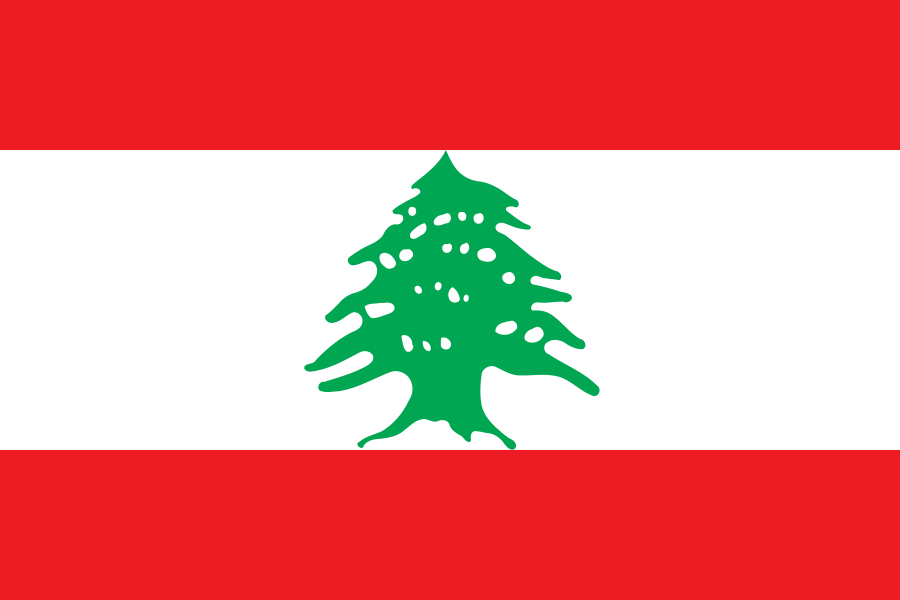
- Lebanon's Cedars are ancient trees dating back thousands of years, featured on the national flag and mentioned in biblical texts
- Byblos is one of the world's oldest continuously inhabited cities, with settlements dating back over 7,000 years
- The Phoenician alphabet developed in Lebanon became the basis for most modern alphabets including Greek, Latin, and Arabic
- Lebanon was once called the "Switzerland of the East" for its banking sector, tourism, and mountain resorts
- The Roman temples of Baalbek are among the largest and best-preserved Roman ruins in the world
- Lebanese cuisine is celebrated globally, with dishes like hummus, tabbouleh, and falafel becoming international favorites