Syria Map
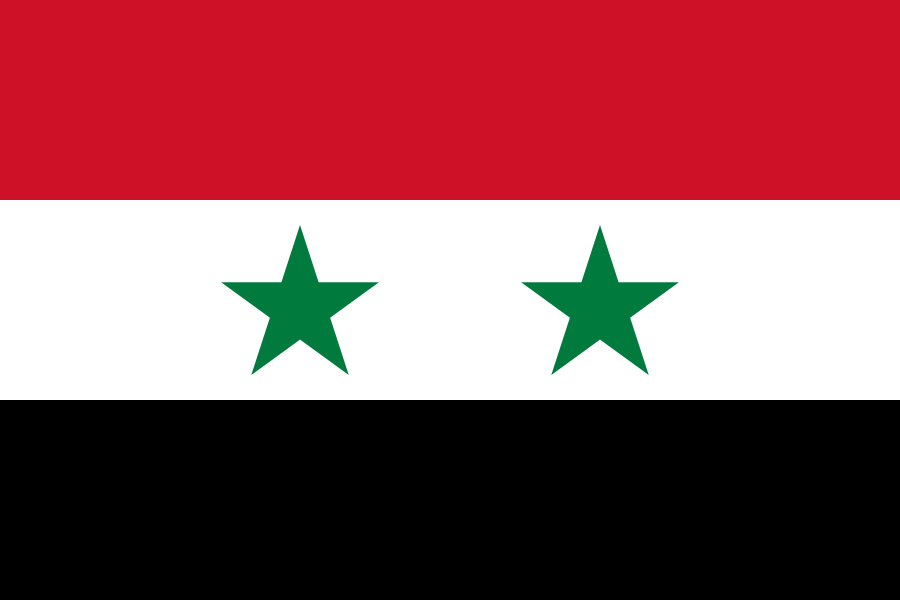
Capital: Damascus
Population: 25,620,427
Area: 185,180 km²
Currency: SYP
Languages: Arabic
Religions: Islam, Christianity
Time zone: UTC+3
Syria is a country located in Western Asia, positioned at the crossroads of the Mediterranean Basin and the Middle East. Covering an area of 185,180 square kilometers with a population of approximately 25.6 million people, Syria is bordered by Turkey to the north, Iraq to the east, Jordan to the south, Israel and Lebanon to the southwest, and has a Mediterranean coastline to the west. The capital city, Damascus, is one of the oldest continuously inhabited cities in the world, with a history spanning over 11,000 years. Syria has been an independent nation since 1946, though it has faced significant challenges in recent years.
Syria's geography is diverse, featuring coastal plains along the Mediterranean, mountain ranges including the Anti-Lebanon Mountains, the fertile Euphrates River valley, and the Syrian Desert in the east. The country experiences varied climatic conditions, from Mediterranean climate along the coast with hot, dry summers and mild, wet winters, to arid and semi-arid conditions in the interior and eastern regions. The Euphrates River, which flows through Syria, has historically been vital for agriculture and civilization. Mount Hermon, in the Anti-Lebanon range, reaches heights of over 2,800 meters. The geographical diversity once supported extensive agricultural production, though recent conflicts have severely impacted these activities.
Syria's economy has been devastated by ongoing conflict since 2011, with GDP per capita dropping to approximately $2,000. Historically, the economy was based on agriculture, with significant production of wheat, barley, cotton, and various fruits. Oil production was once an important economic contributor, though Syria was never a major oil exporter by regional standards. The service sector, including tourism to historical sites, was growing before the conflict. Traditional industries included textiles, food processing, and handicrafts. The war has resulted in massive infrastructure damage, displacement of millions of people, and economic collapse. Rebuilding the economy and infrastructure remains a monumental challenge requiring political stability and international cooperation.
Syrian culture is one of the world's oldest, with contributions to human civilization dating back millennia. Arabic is the official language, though various minority languages including Kurdish, Armenian, and Aramaic are also spoken. The population is predominantly Muslim, with significant Christian and other religious minorities contributing to the cultural mosaic. Syria has been home to some of humanity's earliest civilizations and has countless archaeological sites, including Palmyra, Aleppo, and Damascus Old City, though many have suffered damage during recent conflicts. Syrian cuisine is renowned throughout the Middle East, with dishes like kebabs, hummus, and baklava being widely celebrated. Traditional music, dance, and crafts, including Damascus steel and Damascene woodwork, reflect centuries of artistic heritage. The ongoing conflict has tragically displaced millions and threatened Syria's rich cultural heritage.
Major Cities
- Damascus - The capital with 2.3 million people, one of the world's oldest continuously inhabited cities dating back over 11,000 years
- Aleppo - Historic northern city with 2.1 million people, once Syria's commercial capital with an ancient souq and citadel
- Homs - Central city with 800,000 people, strategically located at the crossroads between Damascus and Aleppo
- Latakia - Mediterranean port city with 400,000 people, Syria's main seaport with ancient Phoenician origins
- Hama - Historic city with 300,000 people, known for its ancient wooden waterwheels (norias) on the Orontes River
Interesting Facts
- Damascus is often cited as the world's oldest continuously inhabited capital city, with archaeological evidence dating back to 9000 BCE
- The ancient alphabet was developed in Syria around 1400 BCE by the Phoenicians, becoming the basis for most modern alphabets
- Palmyra was a wealthy ancient city and UNESCO World Heritage site, known as the "Pearl of the Desert" before suffering damage in recent conflicts
- Damascus steel was historically renowned worldwide for its exceptional strength and sharpness, used to forge legendary swords
- The Krak des Chevaliers, a Crusader castle in Syria, is considered one of the best-preserved medieval castles in the world
- Syria is mentioned numerous times in biblical texts and was a major center of early Christianity before becoming predominantly Muslim