Uzbekistan Map
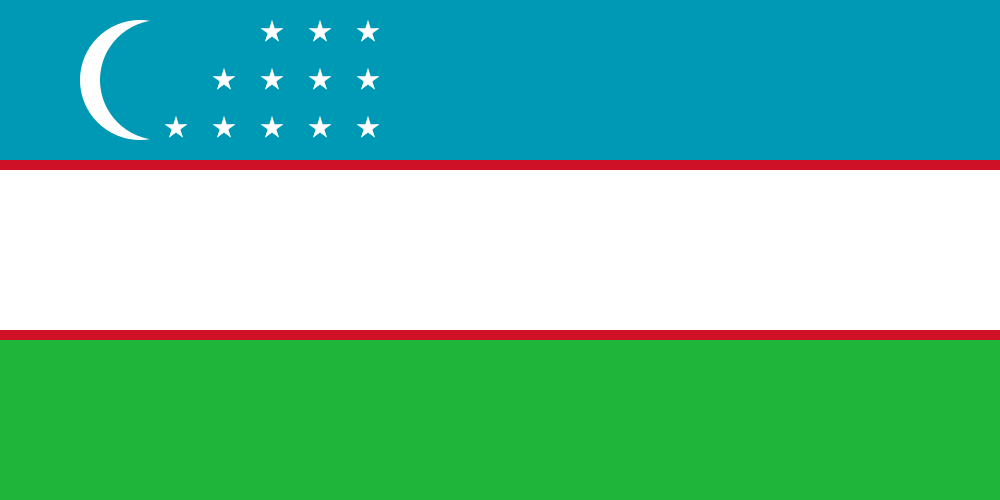
Capital: Tashkent
Population: 37,053,428
Area: 448,978 km²
Currency: UZS
Languages: Uzbek
Religions: Islam
Time zone: UTC+5
Uzbekistan is a doubly landlocked country located in Central Asia, meaning it is surrounded only by other landlocked countries. With an area of 448,978 square kilometers and a population of approximately 37 million people, Uzbekistan is the most populous country in Central Asia. It is bordered by Kazakhstan to the north, Kyrgyzstan and Tajikistan to the east, Afghanistan to the south, and Turkmenistan to the southwest. The capital city, Tashkent, is the largest city in Central Asia with over 2.5 million inhabitants. Uzbekistan gained independence from the Soviet Union in 1991 and has since developed as a presidential republic.
Uzbekistan's geography is diverse, featuring vast deserts, fertile river valleys, and mountain ranges. The Kyzylkum Desert covers much of the central region, while the Fergana Valley in the east is one of the most densely populated and agriculturally productive areas. The country's western region includes the southern shores of the Aral Sea, which has dramatically shrunk due to Soviet-era irrigation projects, becoming one of the world's worst environmental disasters. Mountain ranges including the Tian Shan and Pamir-Alay occupy the eastern regions. Uzbekistan has a sharply continental climate with hot, dry summers and cold winters. The Amu Darya and Syr Darya rivers provide vital water resources for agriculture and population centers. Despite being doubly landlocked, Uzbekistan has diverse ecosystems ranging from deserts to alpine meadows.
Uzbekistan has a developing economy with a GDP per capita of approximately $2,800. The country is rich in natural resources, including significant natural gas reserves (among the world's top 15), petroleum, coal, and minerals like gold, copper, and uranium. Cotton production has traditionally been important, with Uzbekistan being one of the world's largest cotton exporters, though this has come at significant environmental cost. The government has been pursuing economic reforms and diversification since 2016, moving away from the highly controlled Soviet-style economy. Manufacturing includes automobiles, aircraft, agricultural machinery, and textiles. Tourism is a growing sector, capitalizing on Uzbekistan's Silk Road heritage. The country uses the Uzbekistani Som (UZS) as its currency. Recent economic liberalization has improved the business climate, though challenges remain including bureaucracy and the need for further structural reforms.
Uzbek culture reflects a rich history as the heart of the ancient Silk Road, with influences from Persian, Turkic, Mongol, and Russian civilizations. The Uzbek language, a member of the Turkic language family, is the official language and uses a modified Latin script since 1992, though Russian remains widely spoken. The majority of the population is Muslim, primarily Sunni Islam, though Soviet secularization still influences modern society. Uzbekistan is home to some of the world's most magnificent Islamic architecture, with UNESCO World Heritage sites in Samarkand, Bukhara, and Khiva showcasing stunning madrasas, mosques, and mausoleums. The legendary cities of Samarkand and Bukhara were major centers of Islamic scholarship and culture. Uzbek cuisine features dishes like plov (the national dish), samsa, lagman, and shashlik. Traditional crafts include ikat silk weaving, ceramics, and wood carving. Uzbekistan has contributed significantly to Islamic scholarship, science, and literature, producing figures like the mathematician Al-Khwarizmi and the physician Avicenna. Music traditions include classical maqam and folk songs accompanied by instruments like the dutar. Navruz, the Persian New Year, is the most important cultural celebration. The country balances its rich historical heritage with modernization efforts.
Major Cities
- Tashkent - The capital and largest city with 2.5 million people, Central Asia's most populous city and main economic and cultural hub
- Samarkand - Historic Silk Road city with 530,000 people, famous for the Registan Square and stunning Timurid architecture
- Bukhara - Ancient city with 280,000 people, a UNESCO World Heritage site with over 140 architectural monuments
- Namangan - Fergana Valley city with 650,000 people, an important industrial and agricultural center in eastern Uzbekistan
- Andijan - Fergana Valley city with 450,000 people, one of the oldest cities in the region with 2,500 years of history
Interesting Facts
- Uzbekistan is one of only two doubly landlocked countries in the world (along with Liechtenstein), surrounded only by other landlocked countries
- Samarkand is over 2,750 years old and was once the capital of Tamerlane's empire, featuring some of the world's finest Islamic architecture
- The mathematician Al-Khwarizmi, father of algebra, was born in Uzbekistan, as was the physician Avicenna (Ibn Sina)
- Uzbekistan is the world's sixth-largest cotton exporter, though this has caused severe environmental damage including the drying of the Aral Sea
- The country has three UNESCO World Heritage sites: the historic centers of Samarkand, Bukhara, and Khiva's Itchan Kala
- Uzbek plov (rice pilaf) is the national dish, with Tashkent alone having an estimated 1,000 varieties of this beloved meal